news 1
Archaeology student Katie Joss made an unusual discovery during excavations at the Scale Farm on the Scottish island of Rousey. On July 24, 2025, the Institute of Archaeology at the University of the Highlands and Islands (UHI) reported the discovery of an elaborately carved human head made of red sandstone.
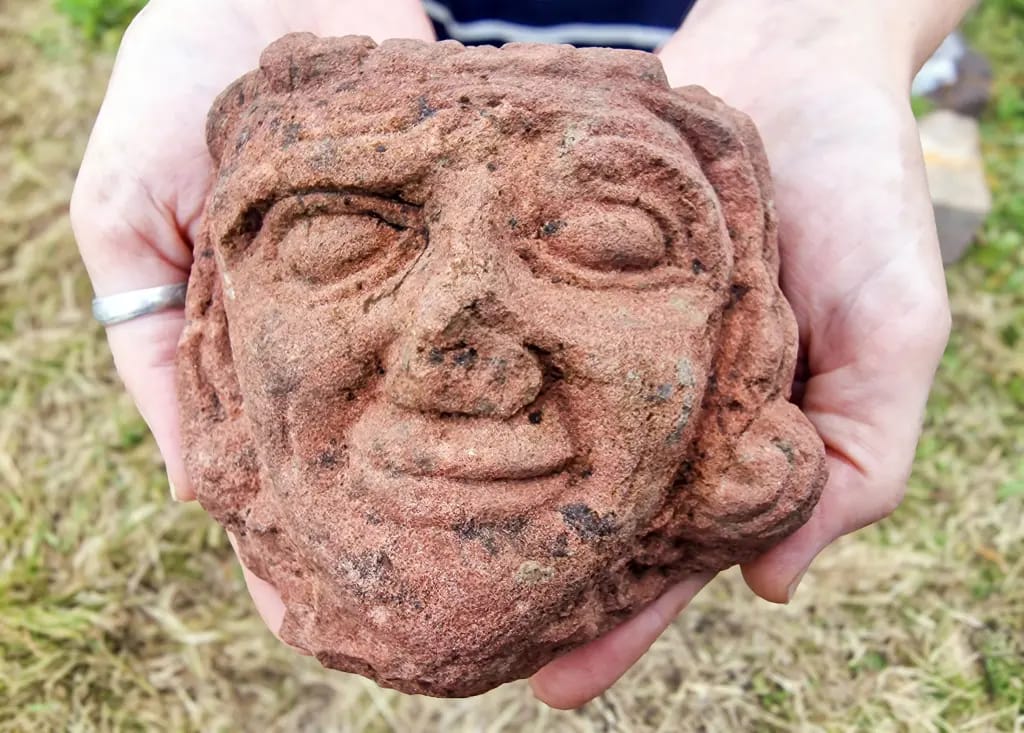
The artifact was discovered near the trench wall during routine work as part of a long-term research project at the institute. The head is made of rich red sandstone with yellow flecks, a material that, according to experts, was mined on the neighboring island of Edey. The same material was used for stucco fragments in the nearby old parish church of St. Mary.
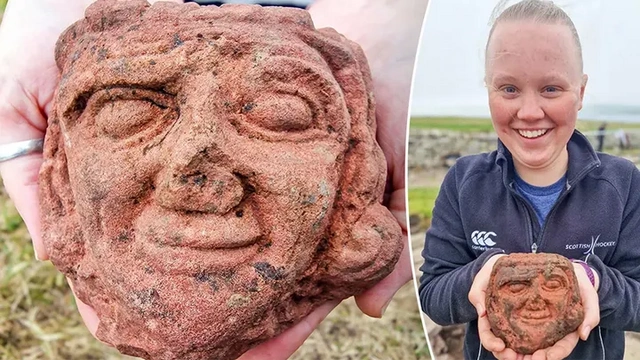
Archaeologist Dan Lee from the University of Orkney noted the uniqueness of the find, stressing that such artifacts had not been discovered on the Orkney Islands before. According to his assessment, the head probably dates back to the Middle Ages and was originally located in the church of St. Mary, and not on the farm.
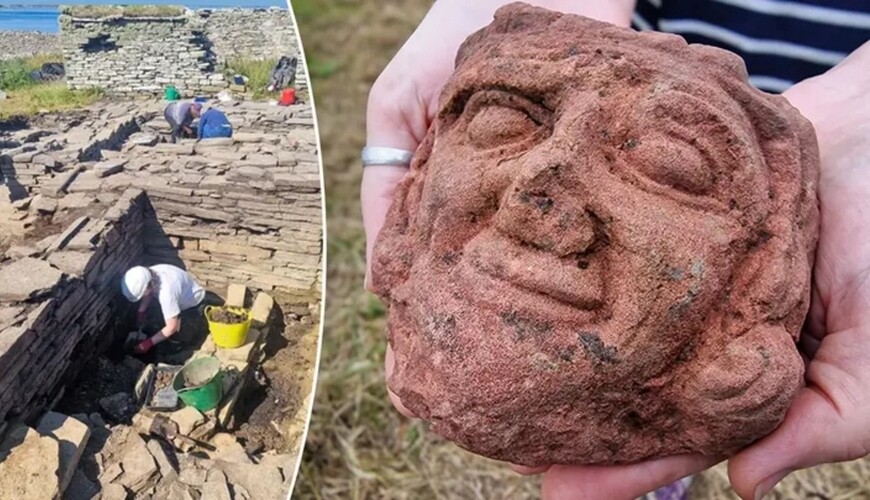
The preservation of the artifact is assessed as very good — only the tip of the nose is damaged. The traces of the master’s chisel are clearly visible on the surface of the head. The sculpture features curly hair and a slight smile.
Archaeology teacher Sarah Jane Gibbon suggested that the presence of such high-quality carvings indicates the existence in the past of a “majestic structure” of high status in the area. The find complements the collection of other red sandstone artifacts found in the Scale, including the capital of the column, but is the first image of a human head.
News 2
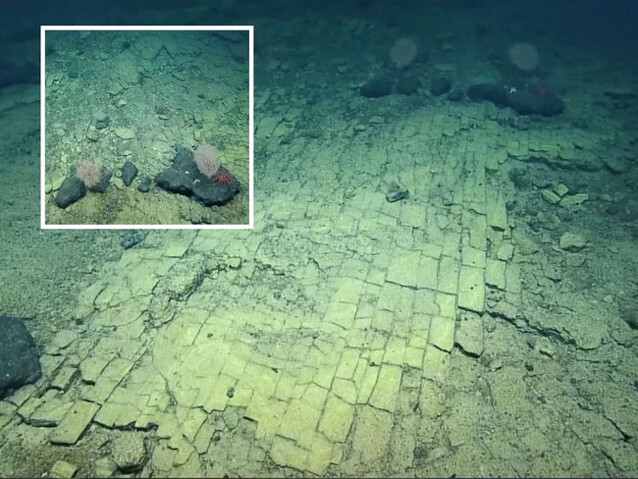
A strange object resembling a cobblestone road was located on the Liliuokalani Ridge in the Papahanaumokuakea National Marine Monument (PMNM) in the Pacific Ocean.
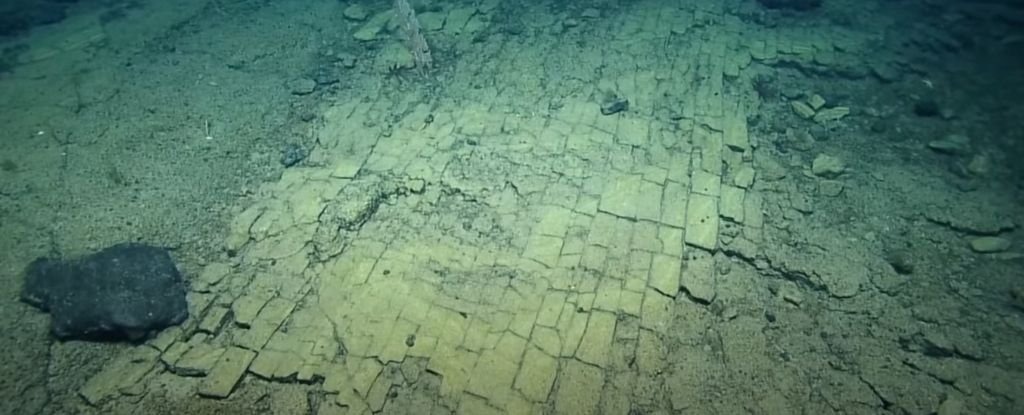
It could be similar to the yellow brick road in The Wizard of Oz, or perhaps a hidden path to the mythical lost city of Atlantis. dailymail.co.uk .
But deep-sea researchers who spotted the incredible rock formation say it’s actually an example of ancient active volcanic geology on the ocean floor near Hawaii.
A strange object resembling a cobblestone road was located on the Liliuokalani Ridge in the Papahanaumokuakea National Marine Monument (PMNM) in the Pacific Ocean.
PMNM is one of the largest marine sanctuaries in the world — larger than all U.S. national parks combined — and researchers have explored only about three percent of its seabed.
The crew of the Nautilus research ship noticed the formation and described it as a “yellow brick road” and “the road to Atlantis” in the discovery video.
“This is the road to Atlantis,” the researcher says over the radio.
“A yellow brick road?” another adds, while a separate team member calls it “weird” and “crazy.”
The team said: "What may look like a ‘yellow brick road’ to the mythical city of Atlantis is actually an example of ancient active volcanic geology!
“Our research corps witnessed incredibly unique and exciting geological formations during a dive on the Liliuokalani Ridge in the Papahnaumokuakea National Marine Monument.”
Nautilus spent most of April studying the geology and biological systems of “seamounts” — seamounts of volcanic origin.

The team added in a statement: "At the top of the Nootka seamount, the team noticed the formation of a ‘dried lake bottom’, which has now been identified as a fragmented stream of hyaloclastite rock (volcanic rock formed as a result of powerful eruptions, where many rock fragments settle to the seabed).
"The unique 90-degree cracks are probably related to the heating and cooling from the numerous eruptions on this scorched outskirts.
“Along the entire seamount chain, the team also took samples of basalts covered with ferromanganese (iron-manganese) crusts from different depths and oxygen saturation, as well as an interesting pumice stone that almost resembled a sponge.”
The research vessel is operated by the non-profit foundation Ocean Exploration Trust, which broadcasts live what its remotely operated diving vehicles see in depth.
The bizarre rock formation was spotted during the NA138 Ocean Exploration Trust expedition to explore Papahnaumokukea National Marine Monument (PMNM) in collaboration with NOAA Ocean Exploration and the Office of National Marine Sanctuaries.
Nautilus has recorded all kinds of unusual marine life, including dumbo octopuses and squid piglets.
The team stated that the main purpose of their latest expedition was to collect samples to determine the geological origin and age of the seamounts in order to better understand the formation of the northwestern Hawaiian Islands.
They added that the seamounts will also be surveyed for biodiversity in the hope of finding rich coral and sponge communities commonly found at these depths.
“Given the estimated Cretaceous age of the seamounts of the Liliuokalani range, relatively thick ferromanganese crusts are expected to have formed on exposed rock surfaces, especially on the slopes of seamounts where sedimentation is minimized,” they added.
An E/V Nautilus representative said: "Our exploration of this never-before-explored area is helping researchers take a deeper look at life on and inside the rocky slopes of these deep, ancient seamounts.
“These studies will help provide basic information about the living communities of seamounts, which can help in taking management and conservation measures.”