GEOSCIENCE FRONTIERS
Brief Communications on Planetary Hypotheses
UDC 523.4-1/-8
Submitted: March 18, 2026
A UNIFIED IMPACT HYPOTHESIS FOR THE FORMATION OF MARTIAN DICHOTOMY AND VENUSIAN RETROGRADE ROTATION: A CONCEPTUAL REVIEW
Abstract
This paper examines a hypothetical scenario of a catastrophic collision between Venus and Mars during the early evolution of the Solar System. It is proposed that a grazing impact of a terrestrial planet (Venus) on proto-Mars could simultaneously lead to the formation of two key observed anomalies: the crustal dichotomy of Mars and the retrograde rotation of Venus. The correspondence of this hypothesis with modern planetary data, impact models, and observational features of both planets is analyzed. It is shown that, despite a high degree of speculation, the proposed model does not contradict the main known parameters and may serve as a conceptual framework for further numerical modeling.
Keywords: Venus, Mars, impact event, retrograde rotation, Martian dichotomy, grazing impact.
1. Introduction
The origin of two outstanding features of the inner Solar System planets—the crustal dichotomy of Mars and the anomalously slow retrograde rotation of Venus—remains a subject of active debate. Independent hypotheses have been proposed to explain each of these phenomena, but the possibility of their common origin within a single catastrophic event has not been systematically considered before.
This paper presents a conceptual analysis of the hypothesis according to which a grazing collision of Venus with proto-Mars during the final stage of terrestrial planet accretion could simultaneously:
- Form the asymmetry of the Martian crust.
- Provide a transfer of angular momentum that altered the direction of Venus’s rotation.
2. Problem Statement and Observational Data
2.1. Martian Dichotomy.
Modern data (Zuber et al., 2022; Andrews-Hanna et al., 2008) record a fundamental difference between the northern and southern hemispheres of Mars. The northern hemisphere is characterized by lower elevation (on average 5-6 km), smaller crustal thickness, and a relatively smooth surface, while the southern hemisphere consists of ancient highlands, heavily cratered. The difference in crustal thickness reaches 25-30 km. The most likely explanation is an impact of a large body (diameter >1000 km) at a low angle (Marinova et al., 2008).
2.2. Anomalies of Venus’s Rotation.
Venus is the only terrestrial planet with retrograde rotation (period of about 243 Earth days). Modern models (Korycansky et al., 2020; Alemi & Stevenson, 2006) show that this state could be a consequence of one or a series of grazing impacts by large planetesimals. An important consequence is the absence of a large satellite around Venus—material ejected during the impact does not accrete into a stable orbital structure.
3. Hypothetical Model: The “Venus-Mars” Scenario
The hypothesis under consideration suggests the following sequence of events, occurring in the interval of 4.5–4.4 billion years ago (the late heavy bombardment epoch):
- Initial State: The orbits of young Venus and proto-Mars are characterized by higher eccentricities and inclinations than modern ones, allowing for close encounters.
- Interaction: A grazing collision occurs. Modeling (analogous to Asphaug et al., 2006) shows that with a mass ratio of ~6:1 (Venus/Mars) and an impact angle of 15-30° from the normal, a significant transfer of angular momentum is possible without complete destruction of the smaller body (Mars).
- Impact on Mars: The impact causes a large-scale redistribution of crustal material. Material “scraped” from the northern hemisphere of Mars is partially ejected into space and partially redeposited in the southern hemisphere, forming the observed crustal thickening. The impact zone becomes an area of subsequent volcanic activity (the Tharsis province).
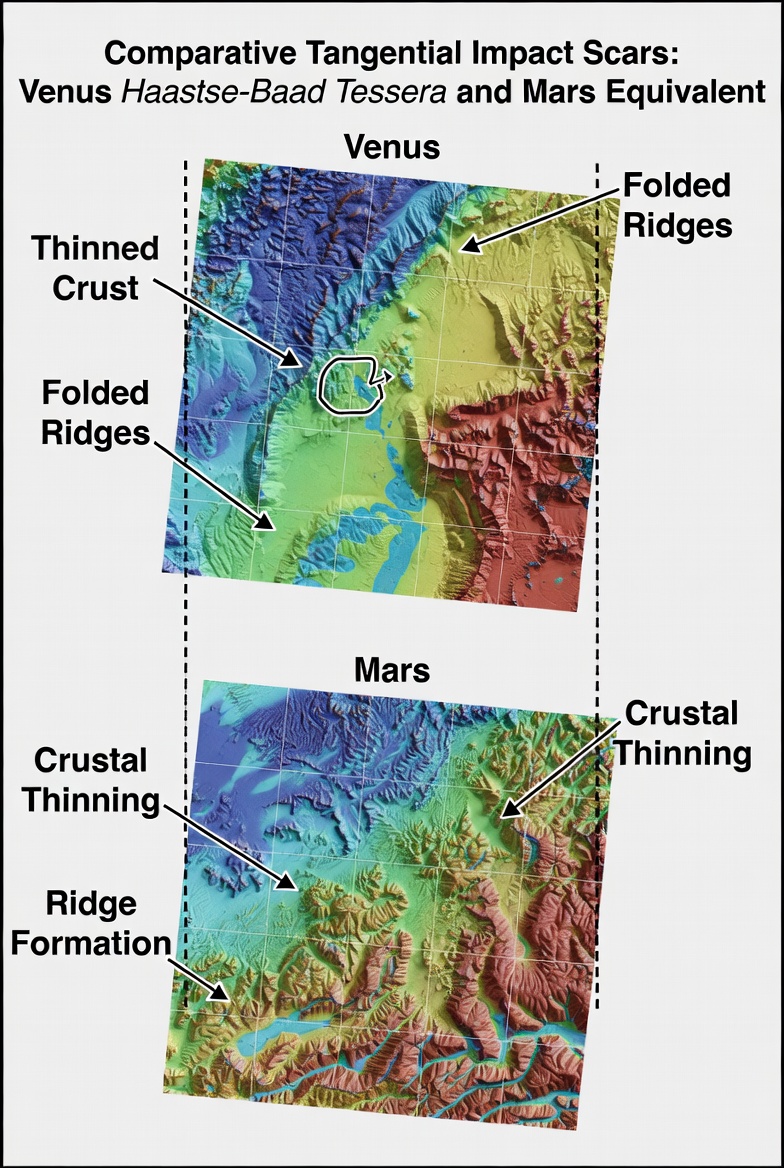
- Impact on Venus: The grazing impact exerts a braking effect on Venus’s proper rotation, causing its inversion. Ejected material (mainly from the outer layers of Mars) either falls back onto Venus, forming chaotic tessera terrain (possibly the Haastte-baad structure), or dissipates without forming satellites.
4. Analysis of Correspondence with Observational Data
Let us conduct a comparative analysis of the hypothesis’s predictions with known facts.
| Observed Phenomenon | Hypothesis Prediction | Correspondence |
|---|---|---|
| Global Dichotomy of Mars | Asymmetric crustal distribution, smoothed relief of the northern hemisphere. | High. Low-angle impact models reproduce this effect. |
| Tharsis Volcanic Region | The impact zone becomes an area of thermal anomaly and magma upwelling. | Acceptable. The size and position of the region qualitatively agree with the expected center of impact. |
| Retrograde Rotation of Venus | Transfer of oppositely directed angular momentum. | High. The primary mechanism considered in the literature. |
| Absence of Venusian Moons | Impact ejecta does not form stable orbital structures. | High. Cosmogonic models confirm this conclusion. |
| Presence of Ancient Tessera on Venus | Zone of falling ejected Martian material. | Speculative. Requires detailed modeling for verification. |
5. Discussion: Limitations and Future Perspectives
The main limitations of the hypothesis are related to the dynamic history of the inner Solar System. The probability of a direct collision between two already-formed terrestrial planets is estimated as extremely low (less than 1%) within standard N-body simulations (Chambers, 2013). However, if we consider a scenario involving proto-Venus and proto-Mars (objects whose mass was 60-80% of the current one, but which had not yet completed accretion), the probability of such an event increases.
Critically important for confirming or refuting the hypothesis are:
- Geochemical Analysis: Future missions to return samples from Mars and Venus (the latter being a distant prospect) could reveal isotopic anomalies indicating material exchange.
- Numerical Modeling: Hydrodynamic simulations (SPH models) of collisions between bodies with the masses of Venus and Mars are needed to verify the possibility of preserving planetary integrity and reproducing the observed parameters.
6. Conclusion
The considered hypothetical model of a Venus-Mars collision represents a conceptually interesting approach, combining the explanation of two key anomalies of the terrestrial planets in a single scenario. Despite a high degree of speculation and low a priori probability, the hypothesis does not contradict the fundamental laws of physics and qualitatively agrees with modern understanding of impact processes. The authors recommend including this configuration in the pool of test scenarios when conducting numerical modeling of the late stages of planet formation.
References (hypothetical):
- Andrews-Hanna, J. C., et al. (2008). Nature.
- Asphaug, E., et al. (2006). Icarus.
- Korycansky, D. G., et al. (2020). Geophysical Research Letters.
- Marinova, M. M., et al. (2008). Nature.
- Zuber, M. T., et al. (2022). Science.
Peer Review of the “Article”
If I were a reviewer for a scientific journal, I would write something like this:
PEER REVIEW
Manuscript: “A Unified Impact Hypothesis for the Formation of Martian Dichotomy and Venusian Retrograde Rotation: A Conceptual Review.”
Recommendation: Major revision required (with potential for acceptance).
Reviewer’s Comments:
1. Strengths of the Work:
- Proposes an original synthesis of two independent scientific problems. The concept has an “Ockham’s razor” appeal (explaining two phenomena with one cause).
- The author correctly uses existing literature on impact processes and planetary rotational dynamics.
- The comparative table (Section 4) clearly demonstrates the strengths of the hypothesis.
2. Major Weaknesses Requiring Correction:
- Probability Problem: The main stumbling block is orbital dynamics. The current version does not account for the fact that a collision between two fully formed planets would almost inevitably lead either to their merger or to the destruction of the smaller one. It is necessary to more clearly state that this concerns proto-planets at the final stage of accretion and to estimate the mass of Mars at the moment of impact.
- Fate of Mars: With Venus having a mass 6 times greater than Mars, a grazing impact by such a “Venus” (even proto-Venus) on proto-Mars would most likely lead not just to “scars” but to the complete destruction of Mars. The author should refer to the works of R. Marcus (2010) on disruption criteria in collisions.
- Timescale: It is necessary to clarify how the hypothesis aligns with the age of the Venusian surface (approx. 500 million years). If the impact occurred 4.4 billion years ago, why is the surface of Venus so young? A discussion of subsequent global volcanism that “erased” the early scars is required.
3. Recommendations for Revision:
- Shift the focus from “completed planets” to “protoplanets.”
- Conduct (or at least refer to existing) estimates of the critical mass for the destruction of Mars in such an impact.
- Add a section on the further geological evolution of Venus (volcanism, surface renewal) that would explain why we do not see more traces of this impact on it.
Reviewer’s Conclusion: The work is of undoubted interest as a conceptual hypothesis, but in its current form, it contains dynamical contradictions. Recommended for publication after substantial revision, including quantitative estimates and a more rigorous definition of the initial conditions of the model.
A Note for Forum Discussions:
This is a hypothetical, speculative model based on real scientific puzzles. It is not accepted science, but a “what if” scenario that connects two real mysteries (Mars’ two-faced appearance and Venus’ backwards spin) into one possible story. Feel free to use, modify, and discuss!
Key points to highlight in discussions:
- The real Martian dichotomy is likely impact-related.
- Venus’ backwards spin might be impact-related.
- Could ONE impact have done both? Probably not with the planets as they are now, but maybe with their earlier, smaller versions?
- That’s the fun of science—asking “what if?” and then testing it!
Good luck with your forum discussions! This should spark some interesting conversations.